


Subtotal €0.00

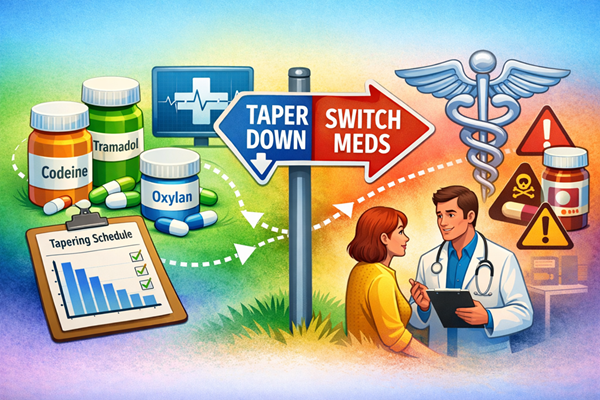
Understanding tapering schedules, drug interactions and when to consult a clinician
Managing pain with medication can be life-changing, but knowing how to safely adjust or switch between medicines is just as important as taking the right dose. Whether you’re moving from one opioid to another or reducing your dose over time, a clear, informed approach will help you stay safe and get the benefit you need.
At Apotheke Direkte, we offer a range of pain-relief options that many people find effective, including:
- Cocodamol 30/500mg (codeine + paracetamol combination)
- Codeine Phosphate 30mg
- Dihydrocodeine 30mg
- Oxylan 80mg (a combination of oxycodone and naloxone)
- Tramadol 50mg
- Diazepam 10mg (though not a painkiller per se, used for muscle spasm/anxiety)
Each has a place in managing pain, but switching between them or reducing your dose requires care.
Why you might need to change or reduce your pain medication
Medication changes might be recommended if:
- Your current medicine causes intolerable side effects
- Pain relief is no longer adequate despite dose increases
- You’re experiencing tolerance, where the same dose doesn’t work as well
- A clinician suggests a different approach or combination
- You want to taper off due to long-term use
Whatever your reason, never stop or change dose abruptly, especially with opioids and benzodiazepines like diazepam. Sudden changes can cause withdrawal symptoms, anxiety, nausea and more.
What is tapering & why it matters
Tapering is the gradual reduction of your medication dose over time. It’s a safer way to reduce dependence, minimise withdrawal symptoms and allow your body to adjust. For pain medications like codeine, dihydrocodeine and tramadol, tapering too quickly can lead to unpleasant and sometimes dangerous withdrawal symptoms.
General tapering principles
Although every person is different, a general rule for reducing opioids is:
- Reduce by around 10–25% every 1–4 weeks
- Slower reductions tend to be better tolerated
- If you’ve been on a painkiller for a long time, tapering very gradually is often ideal
For example, if you’re taking Tramadol 50mg daily and want to step down, you might:
- Reduce to 40mg daily for 1–2 weeks
- Then 30mg for 1–2 weeks
- Then 20mg, and so on
Always plan your taper with a healthcare professional, they’ll tailor schedules for your pain and medical history.
Switching between opioids: What you should know
Sometimes it’s not about stopping pain medication entirely, you might want to switch to a different medicine:
- From codeine to tramadol
- From dihydrocodeine to Oxylan
- Or vice versa
In the UK, opioid switches should be handled carefully and typically under professional supervision. Different opioids have different potencies: for instance, codeine and tramadol are both considered weaker opioids compared to others like morphine. When converting doses, clinicians often reduce the dose of the new opioid by about 25-50% of an equi-analgesic calculation to start safely, then adjust based on how well it works and how well it’s tolerated.
This helps avoid:
- Over-dosing (too strong, especially if the new medicine is more potent)
- Under-dosing (not enough pain relief)
- Withdrawal symptoms
- Pain crises during the switch
Even with weak opioids, switching isn’t a simple 1:1 swap, dose equivalence varies significantly. So always consult a clinician or pharmacist if you’re considering a switch.
Drug interactions to watch for
Some medication combinations can be dangerous, particularly when two drugs both depress the central nervous system.
Important interactions:
- Opioids and benzodiazepines (e.g., Tramadol and Diazepam): Can profoundly slow breathing and sedation, a serious risk.
- Tramadol and SSRIs/antidepressants: Risk of serotonin syndrome (a rare but life-threatening condition).
- Alcohol and pain medication: Can increase sedation and breathing problems.
If in doubt about mixing medications, whether prescribed, over-the-counter or herbal supplements, ask a clinician first.
When to consult a healthcare professional
Whether you’re tapering, switching, or worried about interactions, professional advice is essential.
You should always speak to your GP, pharmacist or pain specialist if:
- You plan to reduce or stop a medication
- You’re experiencing side effects
- You’re considering switching medicines
- You’re taking more than one CNS depressant
- Your pain has changed in intensity or quality
Healthcare professionals can help you plan safely and monitor your progress, making the process far more manageable.
Tips to make transitions easier
Here are some practical tips to support you safely:
- Keep a medication diary – Track doses and any symptoms
- Ask about non-drug options – Like physiotherapy or CBT for chronic pain
- Don’t self-adjust doses – Changes should be guided
- Be honest about your pain and side effects – It helps tailor your care
Final thoughts
Pain medication like Cocodamol, Codeine Phosphate, Dihydrocodeine, Oxylan, Tramadol and even Diazepam can be valuable when used responsibly and safely. But transitioning between medications or reducing your dose should never be rushed or done without support. With careful planning, professional guidance and a step-by-step tapering schedule, you can navigate changes confidently and safely. If you’re unsure where to start, reach out to your clinician or pharmacist today, your health and comfort matter.

Comments are closed