


Subtotal €0.00

If you’re comparing Codeine, Tramadol and Dihydrocodeine, you’re already past the basics. This isn’t about what a painkiller is. You’re trying to work out which one will actually control your pain, how long it will last, and whether it’s worth stepping up.
Most comparisons get this wrong because they reduce everything to “strength”. In reality, strength is only one part of the decision. Duration, consistency and type of pain matter just as much.
So instead of vague claims, here’s how these three actually compare when you strip it back to real use.
How their strength actually compares
If you line them up in simple terms:
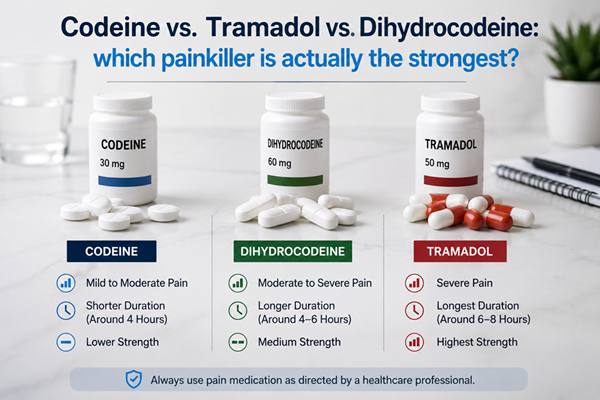
- Codeine sits at the lowest level and is typically used for mild to moderate pain
- Dihydrocodeine is a clear step up and offers more consistent relief
- Tramadol is generally the strongest overall, especially for more complex or persistent pain
That sounds straightforward, but it only tells part of the story.
Strength on paper doesn’t always match how a drug performs in your body.
Why Codeine feels weak for some people
Codeine depends on your body converting it into morphine before it works. That conversion varies from person to person.
In practice, this means:
- Some people get solid relief
- Others feel almost nothing
- The same dose can perform very differently between users
A medication such as Codeine tends to work best when pain is still manageable and short-term. Once pain becomes more persistent or intense, its limitations show quickly.
Where Dihydrocodeine changes things
Dihydrocodeine removes some of that inconsistency. It acts more directly, which is why it often feels like a noticeable step up rather than a small adjustment.
This is usually the point where people move when codeine stops delivering reliable relief.
It suits situations where pain is:
- Clearly beyond mild
- Lasting longer than expected
- No longer controlled by entry-level medication
It fills a very specific gap without immediately jumping to the strongest option.
Why Tramadol is considered the strongest
Tramadol stands apart because it doesn’t rely on a single mechanism.
It works as an opioid, but also affects how the brain processes pain signals. That second effect is what makes it more effective for certain types of pain, particularly nerve-related pain.
In real terms, tramadol:
- Covers a wider range of pain types
- Lasts longer in most cases
- Feels like a bigger step up than expected
This is why Tramadol typically is used when other options are no longer enough.
Onset and duration: Where decisions actually get made
Two drugs can feel similar in strength but behave very differently over time.
Codeine usually starts working within 30 to 60 minutes and wears off after around 4 hours.
Dihydrocodeine follows a similar pattern but often holds slightly longer and more consistently.
Tramadol may take longer to fully kick in, but once it does, it can provide relief for 6 to 8 hours.
This creates a practical trade-off:
- Codeine gives quicker, lighter relief
- Dihydrocodeine offers more stable control
- Tramadol provides longer coverage with stronger impact
Real-world example: How this plays out
Imagine three different situations.
A mild back strain after lifting something awkward. The pain is annoying but manageable. Codeine is usually enough here.
Now take ongoing joint pain that hasn’t improved over time. Codeine starts to feel unreliable. This is where Dihydrocodeine becomes the logical step.
Finally, consider post-surgical pain or a condition that disrupts sleep and daily function. At this point, tramadol is often required because the other options no longer provide sufficient control.
Same category of medication. Completely different outcomes depending on the situation.
What actually limits “strength”
This is where most people make the wrong decision.
All three medications come with trade-offs:
- Drowsiness
- Nausea
- Constipation
These increase as you move up in strength.
More importantly, tolerance builds over time. If you move to a stronger option too early, your body adapts faster, which reduces long-term effectiveness.
So the real goal is not to take the strongest option available. It’s to take the lowest level that actually works.
Which one should you choose?
You don’t choose based on which sounds strongest. You choose based on fit.
Think in terms of progression:
- If your pain is still manageable, codeine is usually enough
- If relief becomes inconsistent, dihydrocodeine is the next step
- If pain is clearly beyond moderate or affecting daily life, tramadol is typically used
That progression exists for a reason. Skipping steps usually leads to more problems later.
Where Apotheke Direkte fits in
Once you understand the differences, the next step is access to the right option.
Apotheke Direkte provides commonly used treatments including codeine phosphate, tramadol and dihydrocodeine, allowing you to match the medication to your actual level of pain rather than guessing.
The important part is not just availability, but making the right choice based on how these medications behave in practice.
Final takeaway
There isn’t a single “strongest” painkiller that works best in every situation.
Codeine is the weakest, but often sufficient.
Dihydrocodeine fills the gap when codeine stops working.
Tramadol is the strongest overall, especially for more complex pain.
The real decision is not about force. It’s about control.
Choose based on what your pain actually requires, not what sounds most powerful.

Comments are closed