


Subtotal €0.00

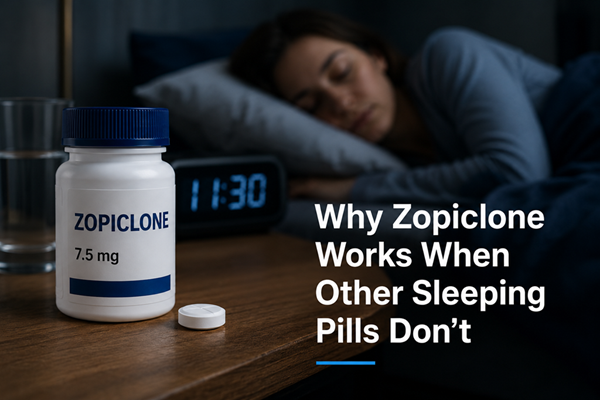
You take a sleeping tablet expecting relief, but nothing changes. You’re still awake, still restless, still watching the clock. Or you fall asleep, only to wake up a few hours later with your mind fully active again.
This is where most people start looking at stronger options. Not because they want to, but because what they’ve already tried has stopped working, leading them to seek alternatives that may provide better results for their sleep issues.
Zopiclone is often the next step. And for many people, it works when other sleeping pills don’t. But that only happens under specific conditions. Outside of those, it fails just as quickly as anything else.
Why some sleeping tablets stop working
Sleep medication doesn’t fail randomly. There’s usually a clear reason behind it.
The most common is tolerance. Your brain adapts to repeated signals. What once slowed things down starts to feel normal, which means the same dose produces less effect.
Another issue is mismatch. Not all sleep problems come from the same cause.
If your issue is a racing mind, a mild sedative may not be strong enough. If your issue is pain or anxiety, a standard sleeping tablet might not address the real problem at all.
This is why people often say “it worked at first, then stopped.” The medication didn’t change. The situation did.
What makes Zopiclone different?
Zopiclone works more directly on the brain’s sleep system. Instead of gently encouraging sleep, it creates a more immediate slowing effect.
This is why it often feels stronger, even if the dose isn’t dramatically higher than other options.
People typically notice:
- Faster transition from awake to asleep
- Less mental resistance at bedtime
- A more noticeable “switch-off” effect
That direct action is the reason it succeeds where lighter sleep aids fail. It doesn’t rely on gradual calming. It forces a shift.
When Zopiclone tends to work best
Zopiclone is most effective when the problem is clearly defined rather than complex or mixed.
It usually works well when:
- Falling asleep is the main issue, not staying asleep
- The mind feels active or overstimulated at night
- Previous mild sleep aids have had little or no effect
- Short-term intervention is needed to stabilise sleep
In these cases, the stronger and more direct mechanism does exactly what it’s supposed to do.
When Zopiclone fails
This is the part most people don’t get told.
Zopiclone doesn’t solve every sleep problem. It only works when the cause of insomnia matches how the drug behaves.
It tends to fail when tolerance builds quickly. After repeated use, the same dose produces less sedation, which leads people to think the medication has stopped working entirely.
It also struggles when sleep disruption is driven by something else.
If pain is waking you up, Zopiclone may help you fall asleep but won’t keep you asleep. If anxiety is causing repeated waking cycles, the effect may wear off too early. Even a potent sedative won’t correct the underlying rhythm if your sleep pattern is irregular.
Timing errors also contribute to the problem. Taking it too early, too late, or without allowing proper sleep time can reduce its effectiveness significantly.
Resetting your sleep cycle properly
Resetting your sleep cycle properly is where most people go wrong. They rely entirely on medication without adjusting the surrounding behaviour, such as establishing a consistent sleep schedule and creating a relaxing bedtime routine.
Sleep timing reset
Going to bed and waking up at inconsistent times weakens the body’s natural rhythm. Even strong medication has difficulty overriding this issue in the long term.
Stimulation reduction
Late-night screen use, work, or high mental activity keeps the brain active. Zopiclone can override this state temporarily, but not indefinitely.
Medication timing
Taking it too early leads to wasted effect. Taking it too late leads to next-day grogginess. The timing window matters more than most people realise.
Used correctly, Zopiclone can help re-establish a pattern. Used incorrectly, it becomes a short-term fix that quickly loses effectiveness, leading to a cycle of dependency and worsening sleep issues over time.
Real scenario: Why it works, then stops
Someone starts with over-the-counter sleep aids. They work for a short period, then become inconsistent.
They switch to Zopiclone. The first few nights are noticeably better. Sleep comes faster, and the struggle at bedtime disappears.
After a couple of weeks, the effect starts to fade. Sleep becomes lighter again. They begin waking during the night.
Nothing “went wrong”. Tolerance built, and the original issue, whether stress, anxiety, or disrupted routine, was never fully addressed.
This is the usual pattern when Zopiclone is used without comprehending its role in the broader context.
Where other medications fit
Zopiclone is not the only option, and it’s not always the right one.
Temazepam works differently and may be more suitable in cases where sleep maintenance is the main issue rather than sleep onset.
Pregabalin becomes relevant when anxiety or nerve-related discomfort is interfering with sleep. In these cases, treating the underlying cause is more effective than increasing sedation.
This scenario is where many people misstep. They often increase the dosage instead of changing their approach.
For those exploring options through Apotheke Direkte, understanding this distinction between escalating strength and changing approach is what prevents trial-and-error cycles and unnecessary frustration, ultimately leading to more effective treatment outcomes.
Final takeaway
Zopiclone works when the problem matches its mechanism.
It is effective for switching off an overactive mind and helping you fall asleep quickly. That’s where it excels.
It fails when the issue is more complex, when tolerance builds without adjustment, or when the root cause of poor sleep is left untouched.
The difference isn’t just the medication. It’s whether you’re solving the right problem.

Comments are closed